中文版
中文版

 Phone:
  Email:
  WhatsApp:
 Description
- Model: ALP121
- Brand: Yokogawa Electric
- Series: CENTUM VP FIO
- Core Function: Connects PROFIBUS DP devices to CENTUM VP
- Type: PROFIBUS-DP Communication Module
- Key Specs: DP Master, 1 port, 9.6 kbps to 12 Mbps
- Maximum Capacity: Up to 32 modules per controller
- Certification: PROFIBUS certification number Z01767
Product Introduction
Yokogawa ALP121 is a PROFIBUS-DP communication module for the CENTUM VP distributed control system. It operates as a PROFIBUS-DP Master and exchanges process data with PROFIBUS DP field devices and I/O equipment connected to the control system. Yokogawa’s hardware documentation identifies it as a one-port communication module for the Field I/O (FIO) architecture.
The communication port supports transmission speeds from 9.6 kbps to 12 Mbps, while the PROFIBUS organization lists the unit as a certified DP Master with certification number Z01767. Yokogawa also states that the module supports redundant communication paths with subsystems, online parameter changes, and additional device installation, which are useful features in operating plants where shutdown windows are limited.
Key Technical Specifications
| Parameter | Specification |
|---|---|
| Manufacturer | Yokogawa Electric Corporation |
| Model | ALP121 |
| Product Type | PROFIBUS-DP Communication Module |
| System | CENTUM VP |
| I/O Architecture | FIO / Field I/O |
| PROFIBUS Role | DP Master |
| PROFIBUS Port | 1 port |
| Transmission Speed | 9.6 kbps to 12 Mbps |
| Maximum Modules | Up to 32 modules per controller |
| Network Interface | PROFIBUS-DP |
| Main Function | Data exchange with PROFIBUS DP I/O devices |
| Redundancy | Redundant communication paths supported in applicable subsystem configurations |
| Online Maintenance | Additional device installation and online parameter changes supported |
| Certification | PROFIBUS Certified, Z01767 |
| Typical Application | Process control, plant monitoring, remote I/O integration |
| Compatible Platform | CENTUM VP, with supported revision requirements |
Yokogawa’s installation guidance lists ALP121 as a one-port PROFIBUS-DP module operating from 9.6 kbps through 12 Mbps. The PROFIBUS Product Finder separately confirms its DP Master classification and 32-module-per-controller capability.
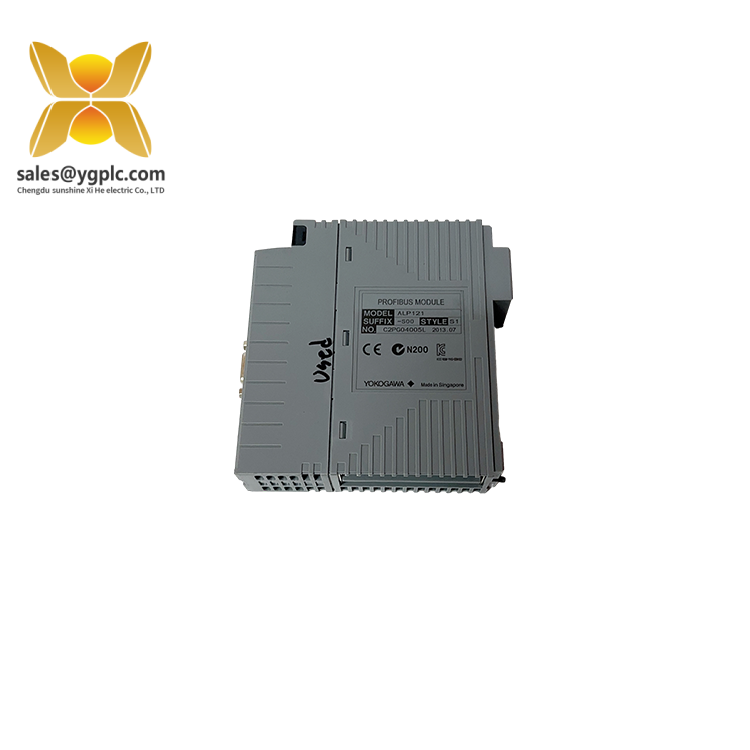
Yokogawa ALP121
Application and Selection Notes
The module is intended for DCS-to-PROFIBUS device integration, not for general-purpose Ethernet-to-PROFIBUS conversion. In a CENTUM VP installation, it sits within the control-system architecture and manages communication with PROFIBUS DP devices.
Typical applications include:
- Remote PROFIBUS DP I/O
- Motor and drive interfaces
- Third-party field devices
- Package-unit controllers
- Process skids requiring PROFIBUS connectivity
- Plant expansions using existing CENTUM VP infrastructure
There is an important software-version point. Yokogawa documentation states that ALP121 is supported by CENTUM VP R5.02 or later in the referenced PRM architecture. Later documentation also records specific engineering and PRM coexistence restrictions depending on CENTUM VP revision. Check the installed software revision before placing a replacement order.
One correction worth making: ALP121 should not be described simply as a “PROFIBUS converter.” Technically, it is a PROFIBUS-DP Master communication module for the Yokogawa control system. That distinction matters when engineering the network and selecting the correct device configuration.
Quality Inspection and Pre-Shipment Checks
- Incoming inspection: Verify the manufacturer label, complete model designation, serial number, board condition, connectors, and original packaging. Source documents should be checked against the procurement record.
- Live test: Where an appropriate CENTUM VP/FIO test environment is available, verify module startup, communication status, PROFIBUS network communication, and device data exchange. Record results in a Test Report.
- Electrical checks: Inspect connector integrity, grounding continuity, and relevant supply paths. Perform insulation testing only where it is appropriate for the installed hardware and test procedure.
- Configuration verification: Record PROFIBUS station parameters, network settings, software revision, and engineering configuration before shipment.
- Final QC: Photograph the nameplate and hardware condition, protect the module against ESD, use shock-resistant packaging, and attach the QC record.
Test photographs and available reports can be supplied with the shipment when requested.
Technical Replacement Risks
Firmware and software revision mismatch. A physically correct module can still create commissioning issues when the CENTUM VP revision or engineering environment is not compatible.
PROFIBUS address errors. The replacement must match the intended network configuration. Record the existing settings before removing the original module.
Bus termination mistakes. PROFIBUS requires correct termination at the ends of the segment. A missing or incorrectly enabled terminator can produce intermittent communication faults that look like module failure.
GSD configuration mismatch. The connected PROFIBUS device must use the correct GSD and module configuration. Do not assume that an identical-looking third-party device has identical configuration data.
Redundancy wiring. Where redundant communication paths are used, check both network paths and the associated system configuration. Replacing one module without checking the redundant side can leave the system in a degraded state.
A good field habit: take clear photos of the old module, connector labels, and network configuration before removal. Ten seconds of documentation can prevent hours of commissioning work.
Purchase and Logistics Notes
For international procurement, describe the item as Yokogawa ALP121 PROFIBUS-DP Communication Module, DP Master, CENTUM VP FIO. Include the complete part identification shown on the nameplate and specify the hardware condition separately: New Original, New Surplus, Refurbished, or Repaired.
For China-bound shipments, the importer should verify the required customs description and any documentation requested for industrial automation communication equipment. The product identification on the commercial invoice, packing list, and shipping label should remain consistent.
For export packing, use an antistatic bag, adequate cushioning, and a rigid carton. Avoid placing heavy accessories directly against the PCB or connector area.
Quick Conclusion
- ALP121 is a Yokogawa PROFIBUS-DP Master communication module for CENTUM VP FIO architecture.
- It provides one PROFIBUS-DP port with communication speeds from 9.6 kbps to 12 Mbps.
- The PROFIBUS Product Finder lists certification number Z01767 and support for up to 32 modules per controller.
- Yokogawa documents support for redundant communication paths in applicable subsystem configurations.
- Software revision, PROFIBUS configuration, and redundancy architecture should be checked before replacement.
FAQ
What is the Yokogawa ALP121?
It is a PROFIBUS-DP Master communication module used to exchange data between CENTUM VP and PROFIBUS DP devices.
Is ALP121 a PROFIBUS-DP slave?
No. The PROFIBUS Product Finder classifies it as a DP Master.
What communication speed does it support?
Yokogawa’s installation documentation specifies 9.6 kbps to 12 Mbps for the PROFIBUS-DP interface.
How many modules can one controller support?
The PROFIBUS organization lists a maximum of 32 modules per controller for this product.
Which Yokogawa system uses ALP121?
It is documented for the CENTUM VP FIO architecture. Yokogawa’s current hardware guide identifies ALP121 as the PROFIBUS-DP Communication Module for this system family.
What should be checked before buying a replacement?
Confirm the CENTUM VP revision, module identification, PROFIBUS network configuration, GSD files, station settings, and whether the installed system uses redundant communication paths. Yokogawa documentation records revision-specific conditions, so software compatibility should be checked rather than assumed.