中文版
中文版

 Phone:
  Email:
  WhatsApp:
 Description
- Model: AFF50D
- Brand: Yokogawa Electric Corporation
- Series: CENTUM / Compact FIO Field Control Unit
- Core Function: Executes redundant process-control operations and interfaces with FIO
- Type: Duplexed Field Control Unit (FCS)
- Key Specs: Dual processors; dual-redundant V Net; 19-inch rack-mountable FIO architecture
- Memory: 32 MB main memory for the compact FCS platform
- Application: CENTUM DCS process-control and field I/O systems
Product Introduction
YOKOGAWA AFF50D is a duplexed Field Control Unit (FCS) for Yokogawa CENTUM systems using Fieldnetwork I/O (FIO). It is a compact, 19-inch rack-mountable controller with redundant processing and V Net communication, intended to keep control execution available if one controller side becomes unavailable. Yokogawa documentation identifies it as the duplexed counterpart to AFF50S.
For maintenance work, the architecture matters more than the cabinet size. The unit can use two CP401 processor modules, two power-supply modules, and redundant V Net couplers; when ESB expansion is required, EC401 modules are installed in the designated slots. That makes it a genuine DCS control platform, not simply a PLC CPU mounted in a rack.
Key Technical Specifications
| Parameter | Specification |
|---|---|
| Model | AFF50D |
| Manufacturer | Yokogawa Electric Corporation |
| Product Type | Duplexed Field Control Unit |
| FCS Type | Compact FIO |
| Mounting | 19-inch rack-mountable |
| Controller Redundancy | Dual / duplexed |
| Processor Modules | 2 × CP401 in the documented configuration |
| Network | Dual-redundant V Net |
| I/O Architecture | FIO |
| ESB Interface | EC401 supported for ESB bus connection |
| Main Memory | 32 MB |
| Power Options | 100–120 VAC, 220–240 VAC, or 24 VDC, depending on suffix |
| Software Compatibility | CENTUM CS 3000 / CENTUM VP release dependent |
| Environmental Options | Basic and ISA Standard G3 configurations available |
| Expansion | FIO nodes and compatible ESB architecture |
| Application | Process control, plant automation, distributed field I/O |
Yokogawa’s ordering specification lists AFF50D as a compact duplexed FIO field control unit with selectable 100–120 VAC, 220–240 VAC, or 24 VDC power configurations. It also documents an ISA Standard G3 option and an ATEX documentation option for applicable installations.
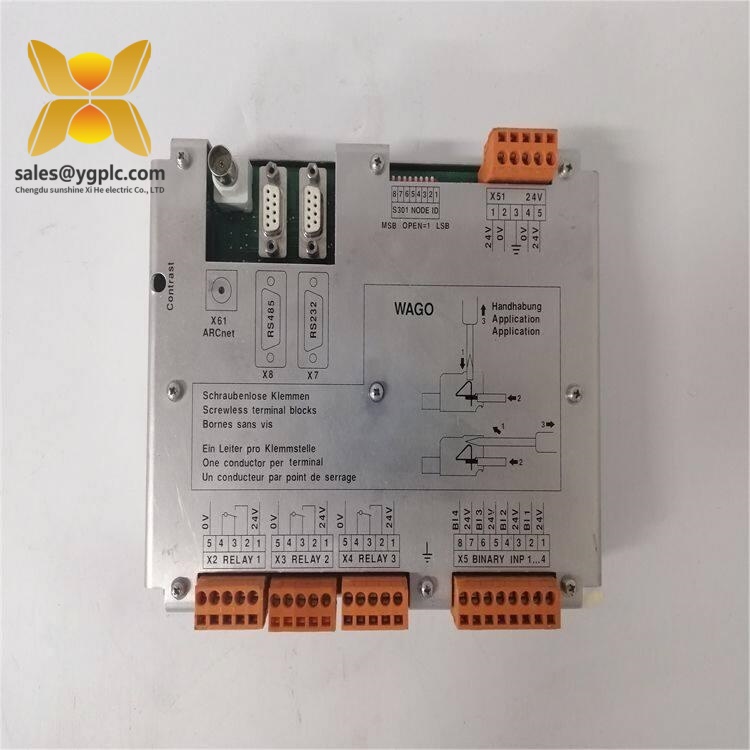
YOKOGAWA AFF50D
Key Features and Practical Value
- Dual-redundant controller architecture for continuous process control.
- Supports FIO-based field I/O in a compact control arrangement.
- Dual V Net communication can be configured for network redundancy.
- Two CP401 processor modules provide the redundant control-processing structure.
- Compatible with ESB bus expansion through the appropriate EC401 configuration.
- Designed for 19-inch rack installation.
- Suitable for plants maintaining established CENTUM control infrastructure.
A useful maintenance point: Yokogawa’s documentation places restrictions on FIO module combinations because of the available power capacity. So, when expanding an installed rack, calculate the module load rather than filling every available slot by assumption.
Typical Applications
This controller is intended for continuous-process environments where loss of a single control-processing path can create an operational problem.
Typical installations include:
- Oil and gas processing
- Petrochemical plants
- Chemical production
- Power and utility systems
- Water and wastewater facilities
- Existing CENTUM CS 3000 or CENTUM VP installations
The compact FCS architecture was specifically designed around FIO processing and distributed field I/O. Yokogawa documentation also lists AFF50D as a supported FCS for turbomachinery I/O applications.
Related Models
AFF50S — Single-control-unit version of the same compact FIO architecture. It is intended for non-duplexed applications where controller redundancy is not required.
CP401 — Processor module used in the AFF50S/AFF50D control architecture. A duplexed configuration uses two processor modules.
EC401 — ESB Bus Coupler Module used to connect the compact FIO controller with an ESB bus node. In a dual-redundant ESB arrangement, two EC401 modules are used.
AFV10D / AFV30D / AFV40D — Other Yokogawa duplexed field-control-unit families supporting different CENTUM FIO configurations.
Installation and Maintenance
Before removing an existing unit, record the processor type, power-supply type, V Net configuration, ESB configuration, slot assignments, and software revision.
Take photographs.
That sounds basic, but it prevents a lot of cabinet rework.
For an installed spare, verify the complete suffix and hardware style. The base model alone does not identify whether the existing system uses AC or DC power, nor does it define every network and certification option. Yokogawa’s ordering table makes these distinctions explicit.
After installation, check processor status, redundant-side health, V Net communication, ESB communication where fitted, and representative FIO operation. For a production DCS, follow the site’s approved change-control and functional-test procedure before returning the controller to automatic operation.
Quality Inspection and Test Procedure
1. Inbound inspection
- Verify source traceability and part number.
- Check serial number and nameplate information.
- Inspect connectors, enclosure, mounting points, and PCB areas.
- Look for corrosion, impact damage, yellowing, or repair evidence.
- Verify manuals and accessories where supplied.
2. Live Test
Use a compatible Yokogawa CENTUM FIO test environment.
- Power-up and processor diagnostics
- V Net communication check
- Redundancy-status verification
- ESB communication check where fitted
- Representative FIO signal testing
- Extended operating test where practical
- Generate a Test Report
3. Electrical Testing
Verify applicable power-input and grounding conditions according to the Yokogawa installation procedure. Insulation or withstand testing should only be performed where the manufacturer’s procedure permits it.
4. Firmware and Configuration Verification
Record processor and hardware revisions where accessible. Preserve configuration information, switch settings, and installed module positions with photographs.
5. Final QC and Packaging
After QC sign-off, place the electronics in an antistatic bag, add protective cushioning, and use a rigid carton. Attach the QC status and inspection date. Test photographs or videos can be supplied with the shipment documentation.
Technical Replacement Pitfalls
Firmware and software mismatch: The controller hardware can be correct while the installed CENTUM release is not. Check the actual system revision before ordering.
Power-supply mismatch: AFF50D configurations support different input-power options. Never energize a replacement until the suffix and supply specification are confirmed.
Wrong redundancy arrangement: A single controller version is not equivalent to a duplexed configuration. Check processor count, V Net couplers, and power supplies.
ESB configuration error: When an ESB bus is duplexed, two EC401 modules are used. The slot arrangement matters.
I/O power capacity: FIO module combinations are subject to power limitations. Adding modules without checking the available capacity can produce an avoidable commissioning problem.
ESD damage: Use an antistatic wrist strap and ESD work surface during replacement. Do not handle controller electronics by exposed circuitry.
Procurement Guidance
For international MRO procurement, specify the complete AFF50D configuration, including suffix, power supply, hardware revision, condition, test status, warranty, country of origin, and lead time.
For export documentation, a precise description such as “industrial DCS field control unit for process automation” is preferable to a vague description such as “electronic board.” The final HS classification should be confirmed against the actual configuration and the destination country’s customs rules.
For China-bound imports, keep the commercial invoice, packing list, serial-number record, and declared product description consistent. A mismatch between the invoice description and the physical nameplate is a common source of customs questions.
Quick Conclusion
- AFF50D is a duplexed Yokogawa FIO Field Control Unit for CENTUM DCS systems.
- The documented architecture uses dual processing, redundant V Net, and compatible FIO/ESB interfaces.
- Power, processor, communication, and software configuration must be checked before replacement.
- FIO expansion should be verified against the controller’s available power capacity.
- For a critical spare, buy by the complete configuration code, not the AFF50D base designation alone.