中文版
中文版

 Phone:
  Email:
  WhatsApp:
 Description
-
- Brand: ICS Triplex / Rockwell Automation
- Series: AADvance
- Core Function: Executes safety logic and manages controller I/O
- Type: Processor Module
- Key Specs: 400 MHz processor, 32 MB SDRAM, 48 I/O modules supported
- Power: Redundant 24 V DC, 18–32 V DC
- Safety Architecture: 1oo1D, 1oo2D, 2oo3D
- Application: Safety instrumented and industrial process control
Product Introduction
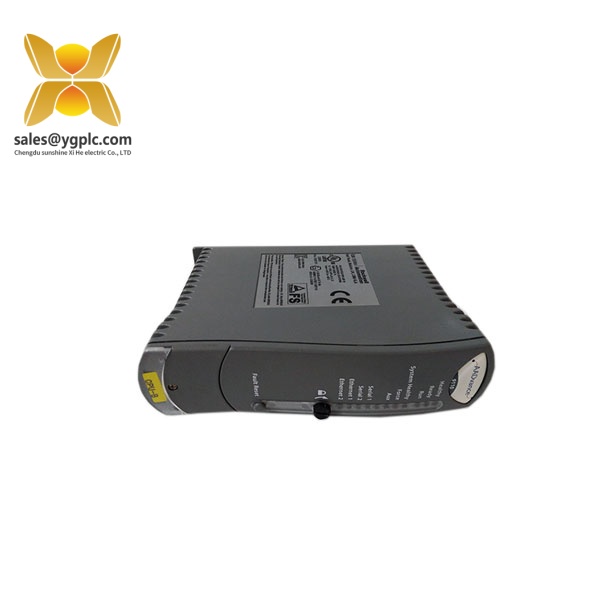
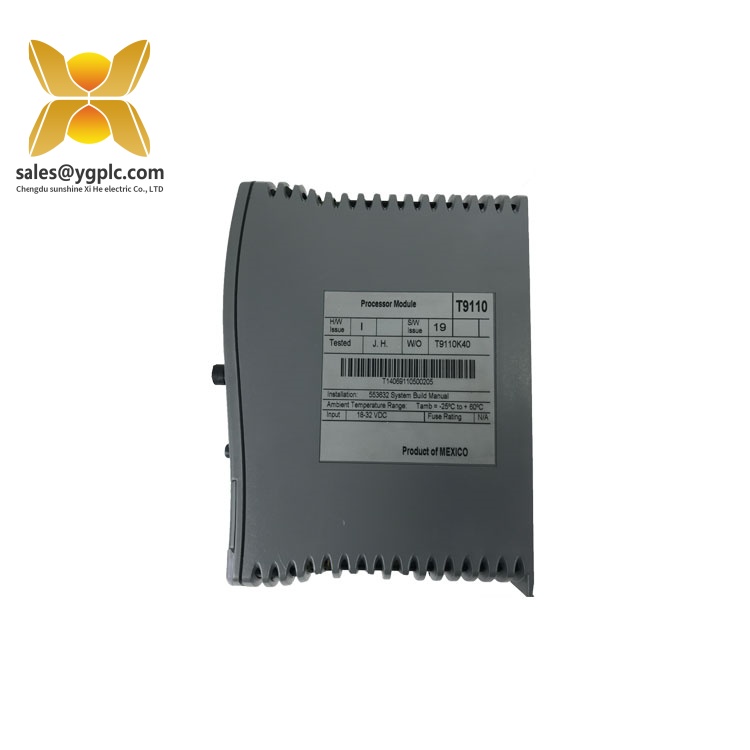
ICS Triplex T9110 belongs to the AADvance processor family and serves as the controller’s central processing module. It executes the application logic, communicates with I/O modules and other processors, runs periodic diagnostics, and exchanges data with HMIs and other control nodes. Rockwell Automation documentation identifies it specifically as the AADvance Processor Module.
The hardware uses a 400 MHz processor, 512 kB boot flash, 512 kB SRAM, 64 MB bulk flash, and 32 MB SDRAM. Depending on architecture, one, two, or three processor modules can be used; two processors support applications up to SIL 3, while three support SIL 3 fault-tolerant and TMR configurations. Up to 48 I/O modules are supported.
Key Technical Specifications
Parameter Specification Manufacturer ICS Triplex / Rockwell Automation Model T9110 Product Type AADvance Processor Module Processor Clock 400 MHz Boot Flash 512 kB SRAM 512 kB Bulk Flash 64 MB SDRAM 32 MB SOE Resolution 1 ms Self-Test Interval Less than 5.5 hours Supported I/O Up to 48 I/O modules Supply Voltage Redundant +24 V DC Supply Range 18–32 V DC Power Dissipation 8 W typical Supported Architectures 1oo1D, 1oo2D, 2oo3D Safety Capability Up to SIL 3 with appropriate redundant configuration System AADvance Safety Controller Rockwell’s current safety documentation continues to list T9110 as an approved AADvance Processor Module across several hardware and software revisions, including newer certified revision groups.

ICS Triplex T9110
Application and Selection Notes
For process plants, burner management, emergency shutdown, and other safety-related applications, the processor is normally installed as part of a redundant AADvance architecture rather than operated as an isolated CPU. The module is galvanically isolated from external power supplies and data links, while internal diagnostics and watchdog supervision continuously monitor processor operation.
A practical procurement point: firmware and hardware revision matter. Rockwell certification documents list specific approved T9110 revision combinations, so an older installed controller should be checked before ordering a replacement. Do not assume every processor carrying the same base model is interchangeable without revision verification.
Quality Inspection and Pre-Shipment Checks
For an industrial spare, inspection should focus on traceability and configuration rather than appearance alone.
- Incoming inspection: Verify manufacturer markings, part number, serial number, hardware revision, connector condition, and any original packaging documentation.
- Functional testing: Where the customer’s configuration permits, perform processor startup and diagnostic checks in an appropriate AADvance test environment and record the results.
- Electrical checks: Verify supply-path continuity and inspect connectors for contamination, corrosion, or mechanical damage.
- Firmware verification: Record the installed firmware/build and compare it with the customer’s existing controller revision before shipment.
- Final QC: Photograph the identification label, seal the processor in an ESD-safe package, and retain the inspection record.
Test reports, photographs, and identification details can be provided with the shipment when requested.
Technical Replacement Risks
Firmware revision mismatch is one of the first things to check. A processor that is electrically correct can still create commissioning problems when the installed system requires a different certified revision.
Redundancy configuration matters. A replacement intended for a dual or triple processor architecture should be synchronized with the existing controller arrangement and configuration.
ESD protection is essential. Use an antistatic wrist strap and grounded work surface when handling the processor. Avoid touching exposed connectors or circuit-board areas.
Do not forget the application configuration. The processor itself is only one part of the safety system. Application logic, I/O configuration, controller addresses, and communication settings all need to match the installed project.
Purchase and Logistics Notes
For cross-border procurement, specify the exact T9110 hardware revision and firmware status on the purchase order. Ask the supplier to confirm whether the unit is New Original, New Surplus, Refurbished, or Repaired. For safety-system spares, the commercial condition should never be left ambiguous.
For export shipments, protect the module against ESD and mechanical shock, then use moisture-resistant secondary packaging where transit conditions warrant it. The commercial invoice should identify the exact manufacturer, part number, quantity, country of origin, and declared value consistently with the shipping documents.

ICS Triplex T9110
Quick Conclusion
- T9110 is the central processor module for the ICS Triplex AADvance safety controller.
- 400 MHz processing, 32 MB SDRAM, and support for up to 48 I/O modules define its core hardware capability.
- Redundant processor configurations support safety architectures up to SIL 3 when the complete system is engineered and certified accordingly.
- Hardware revision and certified firmware compatibility should be checked before replacement.
- It is most suitable for maintaining established AADvance installations rather than selecting a processor in isolation.
FAQ
What is the ICS Triplex T9110?
It is the processor module used in an AADvance safety controller. It executes application logic, manages I/O processing, performs diagnostics, and communicates with other controller components.
What power supply does it use?
The module uses redundant 24 V DC power, with an operating range of 18–32 V DC.
Can one processor provide a SIL 3 safety application?
No. Rockwell documentation specifies two processors for applications up to SIL 3, while three processors provide SIL 3 fault-tolerant/TMR configurations.
How should a replacement be selected?
Match the installed hardware revision, approved firmware/build, controller architecture, and application configuration. Do not rely on the base T9110 designation alone.
Is T9110 still safety-certified?
Rockwell Automation’s current certification documentation lists T9110 processor revisions within the certified AADvance system configuration. The exact revision must still be checked against the applicable certification documentation.
For critical AADvance spare-parts procurement, T9110 should be ordered by complete hardware identity and revision, with firmware compatibility verified before shipment.