中文版
中文版

 Phone:
  Email:
  WhatsApp:
 Description
- Model: SPS5710-2-LF / 51198685-100
- Brand: Honeywell
- Series: Series C Power System
- Core Function: Supplies regulated power to control hardware
- Type: Industrial Power Supply Module
- Key Specs: 20 A output; 24 VDC; 120/240 VAC system
- Product Role: Spare power-supply component for Honeywell Series C systems
Honeywell documentation identifies 51198685-100 as a 20 A power supply for the Series C power system. It is also listed as a spare/loose item in Honeywell Series-C platform documentation.
Product Introduction
Honeywell SPS5710-2-LF, part number 51198685-100, is a 20 A power supply module used within Honeywell Series C power-system configurations. Its job is straightforward: provide the required DC power for process-control hardware while fitting into the system’s power architecture. Honeywell documentation specifically identifies the part as a 20 A Power Supply.
For maintenance teams, the 20 A rating is the key purchasing reference. Honeywell’s Experion PKS documentation also lists 51198685-100 as a supported power module for the Universal Process Cabinet when used with the ATDI power shelf.
Key Technical Specifications
| Parameter | Specification |
|---|---|
| Manufacturer | Honeywell |
| Model | SPS5710-2-LF |
| Part Number | 51198685-100 |
| Product Type | Power Supply Module |
| System | Honeywell Series C Power System |
| Rated Output | 20 A |
| DC Output | 24 VDC |
| AC System | 120/240 VAC configuration |
| Power Architecture | Redundant or non-redundant configurations, depending on system design |
| Compatible Platform | Honeywell Series C / applicable Experion PKS configurations |
| Application | Industrial process-control power distribution |
| Alternate Part Number | 140519-2-LF |
Honeywell’s own Series-C documentation lists 51198685-100 as the 20 A power-supply spare, while current Honeywell documentation also identifies it as an ATDI power module for supported UPC configurations.
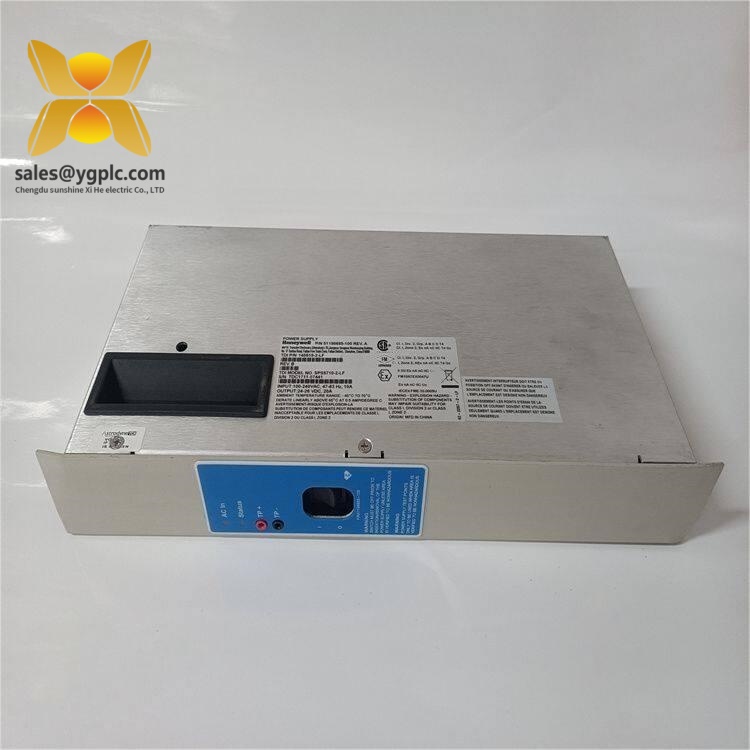
Honeywell 51198685-100
Installation & Configuration Guide
Estimated replacement time: 20–30 minutes, excluding system validation and troubleshooting.
Stage 1 — Pre-Installation
Estimated time: 5–10 minutes
⚠️ Safety first.
- Notify the control-room and production team about the planned intervention.
- Confirm the process is in a safe operating state.
- Follow the site’s electrical isolation and LOTO procedure.
- Isolate the applicable power source before removing the module.
- Wear an ESD wrist strap when handling the replacement unit.
Before removal, photograph the existing power-supply position and associated wiring. Record the module label, part number, revision information, and cabinet location.
Do not assume that a visually similar Honeywell power module has the same electrical configuration.
Stage 2 — Remove the Existing Module
Estimated time: 5 minutes
- Verify that the isolated circuit is de-energized with an appropriate meter.
- Label connected wiring before disconnection.
- Disconnect the wiring according to the applicable cabinet drawing.
- Release the module’s mechanical retaining hardware.
- Remove the old unit carefully.
- Inspect the power-supply connector, terminals, and mounting area for heat damage or corrosion.
Do not pull on cables. If a terminal shows discoloration or insulation damage, investigate the cause before installing the replacement.
Stage 3 — Install the Replacement
Estimated time: 5–10 minutes
- Confirm the replacement label reads 51198685-100 / SPS5710-2-LF.
- Compare the replacement against the removed unit.
- Verify connector and terminal positions against the Honeywell cabinet documentation.
- Install the module in the correct power-system position.
- Restore wiring exactly according to the original documentation.
- Check that all mechanical retaining hardware is secure.
- Perform a visual inspection before energizing.
Do not invent terminal assignments from memory. The exact cabinet configuration should be checked against the applicable Honeywell wiring documentation.
Stage 4 — Power-On and Functional Test
Estimated time: 10–15 minutes
- Confirm the installation is complete.
- Check for loose conductors or exposed wiring.
- Energize the system according to the site’s approved startup procedure.
- Observe the power-system status indications.
- Check the expected DC supply voltage.
- Verify that connected control hardware starts normally.
- Review system diagnostics for power-related alarms.
- Allow the system to operate under normal conditions and confirm stable operation.
Record the replacement date, technician, serial number, and test result in the maintenance log.
Frequently Asked Questions
1. What is Honeywell 51198685-100 used for?
It is a 20 A power supply used in Honeywell Series C power-system configurations. Honeywell’s documentation explicitly lists 51198685-100 as the 20 A power-supply spare.
2. Is SPS5710-2-LF the same part as 51198685-100?
Yes, supplier and technical-reference listings identify SPS5710-2-LF as the model associated with 51198685-100. One technical listing also gives 140519-2-LF as an alternate part number.
3. Can I replace it without checking the cabinet configuration?
Not recommended. The same part number can appear in different system-level power arrangements, including redundant configurations. Honeywell documentation shows 51198685-100 used with specific Series C and UPC power architectures.
4. Is this a 24 VDC power supply?
The available technical listings identify the unit as a 24 VDC, 20 A power supply, while Honeywell’s official documentation confirms the 20 A power-supply designation. For exact input/output limits and installation requirements, use the applicable Honeywell datasheet for the installed configuration.
5. What should I check before ordering?
Use three identifiers: SPS5710-2-LF, 51198685-100, and the existing system configuration. Match the part number first; then verify the power-system architecture, cabinet application, and required condition.
6. Is the part still available?
Current market listings show 51198685-100 offered by multiple industrial automation suppliers, but stock and condition vary. Treat supplier-reported inventory as a commercial quotation point rather than an official Honeywell availability statement.
7. What is the main replacement risk?
The biggest practical risk is configuration mismatch, not simply fitting the module physically. Verify the cabinet drawing, power architecture, wiring, and required output before energizing the replacement. Honeywell’s documentation should take precedence over third-party listings.
Source note: Honeywell documentation supports the 20 A rating, Series C application, and UPC/ATDI power-system usage. Some third-party listings provide additional claims such as exact input range, dimensions, weight, stock, or warranty, but those details are inconsistent across sellers and therefore are not treated as confirmed specifications here.