中文版
中文版
 Phone:
  Email:
  WhatsApp:
 Description
- Model: 51196655-100
- Brand: Honeywell / Honeywell Measurex
- Series: TDC 3000 / TPN Legacy Infrastructure
- Core Function: Supplies regulated DC power to dual-node equipment
- Type: Dual Node Power Supply Module
- Key Specs: 120–240 VAC input; 5/12/27 VDC outputs; 165 W
- Associated Assembly: ACX633
- Lifecycle: Legacy / discontinued; availability is typically through installed-base spare inventory
Product Introduction
The HONEYWELL 51196655-100 is a dual-node power supply module used in Honeywell legacy control infrastructure. Honeywell documentation identifies the part as a “P/S DUAL NODE EC”, while other technical references associate it with the ACX633 power-supply assembly and TDC 3000 installations.
Its electrical role is more specific than a generic cabinet power supply. Published aftermarket specifications identify a 120–240 VAC, 50/60 Hz input with multiple DC output rails at 5 V, 12 V, and 27 V, and a total power rating of about 165 W. Honeywell’s own installed-base documentation also lists this part among the legacy dual-node power supplies used in CE-mark and certain earlier modules.
Key Technical Specifications
| Parameter | Specification |
|---|---|
| Model | 51196655-100 |
| Manufacturer | Honeywell / Honeywell Measurex |
| Product Type | Dual Node Power Supply Module |
| Associated Assembly | ACX633 |
| Typical System | TDC 3000 / legacy Honeywell node infrastructure |
| Input Voltage | 120–240 VAC |
| Input Frequency | 50/60 Hz |
| Input Current | Up to 4 A, published secondary specification |
| DC Outputs | 5 VDC / 12 VDC / 27 VDC |
| Output Current | 20 A / 3 A / 1 A / 0.6 A, configuration-dependent |
| Total Power | Approx. 165 W |
| Connector | 3-pin IEC320 power connector for the EC version |
| Node Architecture | Dual-node |
| Installation | Honeywell legacy control cabinet / node assembly |
| Lifecycle | Discontinued / legacy spare |
| Typical Application | TDC 3000 and related Honeywell installed-base systems |
Honeywell’s own parts documentation identifies 51196655-100 as a dual-node power supply with a 3-pin IEC320 connector and notes its use in CE-mark modules as well as some earlier non-CE modules. (rms-dcs.com)
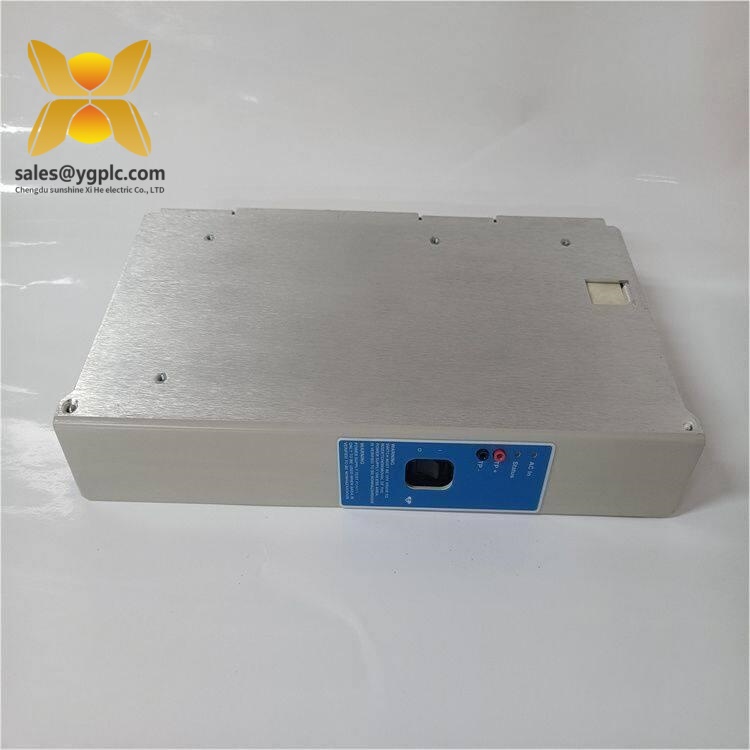
HONEYWELL 51196655-100
Key Features and Practical Value
- Dual-node power architecture for compatible Honeywell legacy equipment.
- Wide 120–240 VAC input range.
- Multiple regulated DC output rails for different internal loads.
- Approximate 165 W total power capacity based on published secondary specifications.
- 3-pin IEC320 input connector on the EC version.
- Designed specifically for Honeywell installed-base hardware.
- Useful as a stocked spare where modernization has not yet replaced the original node infrastructure.
This is not the sort of power supply I would replace by looking only at voltage and wattage. The connector, output-rail allocation, mechanical fit, and node architecture all matter.
Typical Applications
The module is associated with Honeywell legacy process-control infrastructure, including:
- TDC 3000 control systems
- TPN and related legacy Honeywell nodes
- Dual-node electronics assemblies
- EPLCG and associated installed-base infrastructure
- Older process-control cabinets requiring dedicated internal DC rails
Honeywell’s Enhanced PLC Gateway documentation also identifies the part as a dual-node power supply with a 3-pin IEC320 connector.
For maintenance teams, this kind of component is usually purchased as a direct system spare rather than selected as a new universal AC/DC power supply.
Related Models
51402184-100 — Honeywell dual-node power supply using an 8-pin Beau Vernitron connector. Honeywell-installed-base documentation identifies it as the older connector-style alternative for specific modules.
51401497-100 — Earlier Honeywell dual-node power supply referenced as the predecessor to 51402184-100 in legacy hardware.
ACX633 — Assembly designation commonly associated with this power supply in aftermarket technical references.
51190516-100 — Related optically isolated solid-state relay used within associated legacy control infrastructure. It is a different component type and is not a power-supply replacement.
Installation and Maintenance
Before replacement, verify the complete part number, node type, connector style, AC input range, output rails, and cabinet position. Photograph the old power supply and cable routing before removal.
Check the incoming AC supply independently. After installation, measure the 5 V, 12 V, and 27 V rails at the approved test points rather than assuming the module is healthy because the node powers up.
One practical qualification: published aftermarket current ratings can list several output-current figures for the same part family, while Honeywell’s own documents focus more on the assembly identification and system role. For a critical replacement, use the original nameplate and Honeywell engineering documentation as the final electrical reference.
Quality Inspection and Test Procedure
1. Inbound inspection
- Verify part number and serial number.
- Check connector type and nameplate.
- Inspect housing, terminals, fan openings, and PCB areas.
- Look for corrosion, overheating, impact damage, or repair evidence.
2. Live Test
Use a compatible Honeywell legacy node / dual-node power test setup.
- Verify AC input acceptance.
- Confirm power-up behavior.
- Measure all required DC output rails.
- Check output stability under representative load.
- Run an extended powered test where practical.
- Generate a Test Report.
3. Electrical Testing
Use calibrated test equipment to verify input, output, grounding, and continuity. Insulation or withstand testing should be performed only according to the applicable Honeywell procedure.
4. Configuration Verification
Record connector style, node identification, and any internal configuration or jumper settings where applicable. Photograph the original unit before replacement.
5. Final QC
After QC approval, protect the assembly against ESD and mechanical shock. Use antistatic packaging, cushioning, and a rigid carton. Attach a dated QC label, with test photos or video available when required.
Technical Replacement Pitfalls
Connector mismatch: The 3-pin IEC320 version is not automatically interchangeable with older 8-pin Beau Vernitron designs. Check the exact hardware.
Output-rail mismatch: Do not replace the unit based only on “165 W.” The internal 5 V, 12 V, and 27 V rails serve specific system loads.
Wrong node architecture: A general-purpose 24 VDC supply does not reproduce the complete dual-node power function.
Input-frequency assumption: Confirm the actual site supply and the module’s input specification before energizing.
Aged spare condition: Because this is legacy hardware, electrolytic capacitors, connectors, and cooling components deserve inspection even when the unit appears clean.
ESD: Use an antistatic wrist strap and ESD-safe bench. Power supplies connected to control electronics should be treated as system components, not generic electrical accessories.
Procurement Guidance
For international MRO procurement, specify Honeywell 51196655-100 / ACX633, together with the condition, connector style, tested output rails, warranty, country of origin, lead time, and Incoterms.
Honeywell’s own System HINTS documentation placed this part on a Last Time Buy (LTB) list and stated that affected parts were subject to end-of-sale arrangements for the legacy installed base. That makes verified spare inventory especially relevant for plants still operating compatible systems.
For customs documents, a description such as “industrial process-control dual-node power supply module” is more precise than “electronic board.” The final HS classification should be confirmed according to the actual shipment and destination-country rules.
Quick Conclusion
- 51196655-100 is a Honeywell dual-node power supply module associated with legacy TDC 3000 and related infrastructure.
- Published specifications identify 120–240 VAC input and multiple 5/12/27 VDC output rails, with approximately 165 W capacity.
- The EC version uses a 3-pin IEC320 power connector according to Honeywell’s installed-base documentation.
- It is a legacy/discontinued spare, so condition, connector type, and actual test status should be confirmed before purchase.
- For replacement, match the complete electrical and mechanical configuration, not wattage alone.